
Christmas Prime Rib Roast: The Best Easy Christmas Prime Rib Recipe
A Christmas prime rib roast is the centrepiece every Christmas dinner wants: a big, beautiful roast with a crackling herb crust, a juicy pink middle, and a carving moment that stops the whole table. This is the best Christmas prime rib roast recipe for a home cook — an easy Christmas prime rib with a garlic herb butter rub, a foolproof cooking method, and a rich au jus — plus the two methods everyone argues about (the 500-degree method and the reverse sear), exact prime rib roast cooking times and temperatures, bone-in vs boneless, how much prime rib to buy per person, and a full Christmas prime rib dinner menu. Whether you call it a Christmas prime rib, a Christmas standing rib roast, or — if you are in the UK — a Christmas roast beef, this guide covers it: the best prime rib recipe oven method, the best prime rib recipe smoker and grill versions, a prime rib recipe crock pot option, and the Christmas prime rib roast menu that turns one roast into the whole holiday dinner. Searches for prime rib roast recipe jump about 300% in December, so if you are planning Christmas dinner, now is the time to learn how to cook prime rib — and this is the only guide you need.
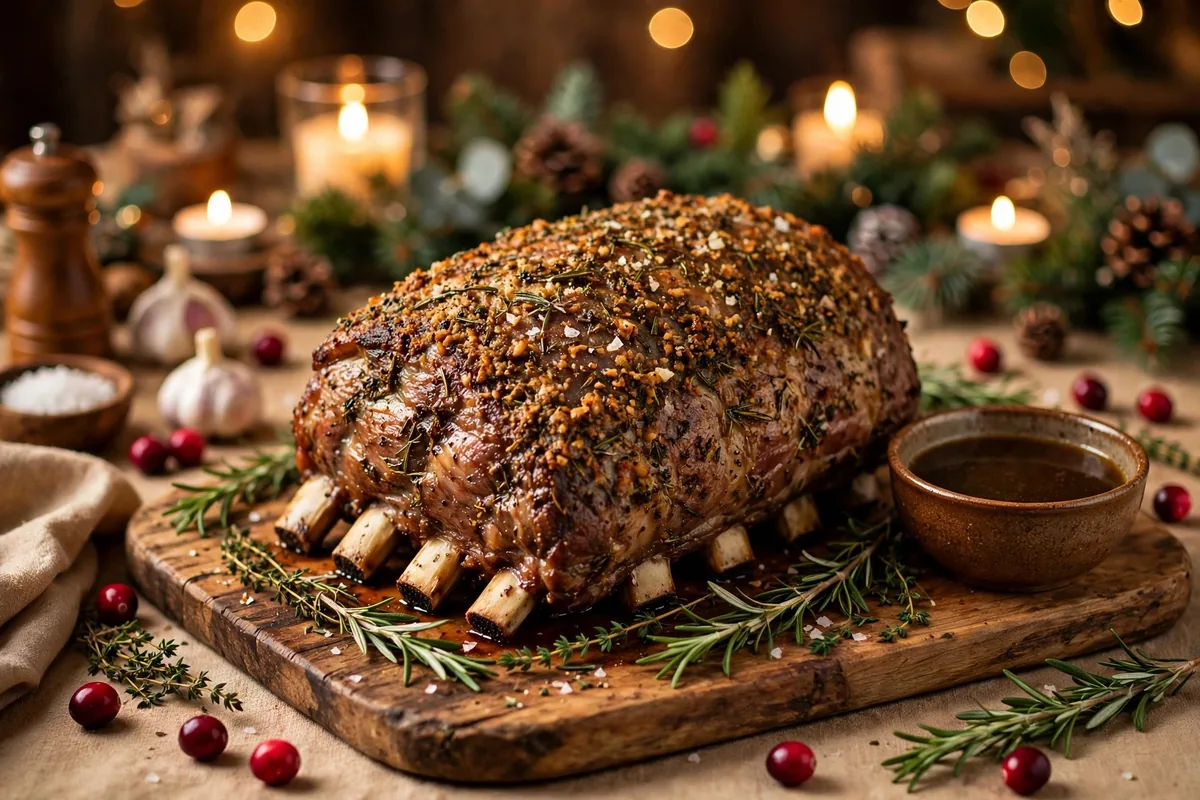
Why Christmas Prime Rib Is the Best Christmas Main
Christmas prime rib is the main dish for people who want Christmas dinner to feel like an occasion. Turkey is traditional, and our Christmas ham is the other classic — but a Christmas prime rib roast is the one that makes guests go quiet when it comes to the table. The crust is dark and crackling, the inside is pink and juicy, and the carving itself is part of the show. A Christmas prime rib dinner is also, honestly, easier than a turkey: there is no brining, no stuffing, no basting every half hour. You rub it, you roast it, you rest it, you carve it — and the oven does almost all of the work while you get on with the sides.
There is a practical reason prime rib wins at Christmas too. A prime rib roast is one of the most forgiving big roasts there is: the thick cap of fat bastes the meat as it cooks, the bones protect the centre from overcooking, and the long rest at the end evens everything out. Even if your timing is a little off, a prime rib roast recipe is hard to ruin — and the leftovers are the best of any Christmas main, sliced thin for sandwiches or warmed gently in au jus. If you have never cooked one, this Christmas prime rib roast recipe is the place to start: it is the easiest prime rib recipe that still tastes like the best prime rib recipe ever, and it works for a small family dinner or a full Christmas prime rib dinner menu for a crowd.
One more thing to know before you buy: prime rib is not a cut, it is a grade and a roast. The cut is the rib roast — ribs six to twelve of the cow — and the same cut is sold as a standing rib roast, a ribeye roast, and in the UK as a roast rib of beef. "Prime" on the label is the USDA grade, the top grade, and it is not the same as the cut: most of what you buy is USDA Choice, which is still excellent for a Christmas prime rib roast. The name changes by country, but the roast does not — and this guide covers every version, from the classic Christmas prime rib roast recipe to the Christmas roast beef the UK searches for every December.
How to Choose the Best Prime Rib Roast
Choosing the roast is half the recipe, and the first choice is bone-in or boneless. A prime rib recipe bone in — a prime rib roast recipe bone in, to use the full search term — is the classic: the bones insulate the meat, add flavour, and give you the dramatic rib bones standing up on the platter. A prime rib recipe boneless is easier to carve and gives you more meat per pound, and a boneless roast ties up neatly into a uniform shape that cooks evenly. Our verdict: buy bone-in for Christmas, and ask the butcher to cut the bones off and tie them back on with string. You get the flavour and the insulation of bone-in, and when the roast is done you snip the strings, lift the bones away, and carve like a boneless roast. It is the best of both — and it is what most good butchers do without being asked.
Next is the grade. USDA Prime is the top grade, with the most marbling, and it is the most expensive — expect prime rib roast cost of roughly $25 to $40 per pound at a butcher. USDA Choice is the grade most people buy, with plenty of marbling for a juicy roast, at roughly $15 to $25 per pound. Choice is the sweet spot for a Christmas prime rib: the fat cap and the slow roast do the work, and the difference from Prime is small once the roast is carved and served with au jus. If you are buying at a warehouse store, prime rib roast Costco is one of the most-searched options for a reason — Costco sells Choice-grade standing rib roasts at the lower end of the range, and a prime rib roast Costco price is usually the best value for a big roast. Whenever you see a prime rib roast on sale near me in December, it is almost always a warehouse or supermarket special — buy it a week ahead, because a prime rib roast for sale in the week before Christmas sells out fast.
Size is the question everyone gets wrong, so here is the rule: half a pound of boneless prime rib per person, or three-quarters to one pound of bone-in prime rib per person. A 3-bone roast weighs about 6 to 7 pounds and serves 6 to 8 people; a 4-bone roast weighs about 8 to 9 pounds and serves 8 to 10; a 5-bone roast weighs about 10 to 12 pounds and serves 12 to 14. If you want leftovers — and you should, because leftover prime rib is the best sandwich meat there is — go up one bone. And when people search "prime rib roast near me" or "standing rib roast near me" in December, what they are really asking is where to buy a good one: a local butcher first, then a warehouse store like Costco, then a good supermarket meat counter. Order a week ahead and tell the butcher the date: a prime rib roast keeps 3 to 5 days in the fridge, so a roast bought on the 20th is perfect for Christmas Day.
Prime rib roast vs ribeye roast is a question that comes up every December, and the answer is simple: they are the same cut. A standing rib roast vs prime rib is the same question — a standing rib roast is a prime rib roast with the bones left in and standing up, and a ribeye roast is the same cut with the bones removed. A ribeye steak is a single slice cut from the same roast. So when you see a "standing rib roast" on the shelf, you are looking at a prime rib roast: buy it, cook it the same way, and call it whatever your country calls it — a Christmas prime rib roast in the US, a roast rib of beef on the bone in the UK, a standing rib roast in Australia and New Zealand.
How to Cook Prime Rib in the Oven
There are two famous ways to cook a prime rib roast in the oven, and this guide gives you both — because the best prime rib recipe oven method depends on your oven, your schedule and how much you like to fuss. If you searched how to cook prime rib roast in oven, this section is the answer: the 500-degree method and the reverse sear below are the only two methods you need. The first is the 500-degree method, sometimes called the closed-oven method. The second is the reverse sear, the method our prime rib roast recipe uses. Both give you a pink, juicy middle and a dark crust. The difference is timing and control.
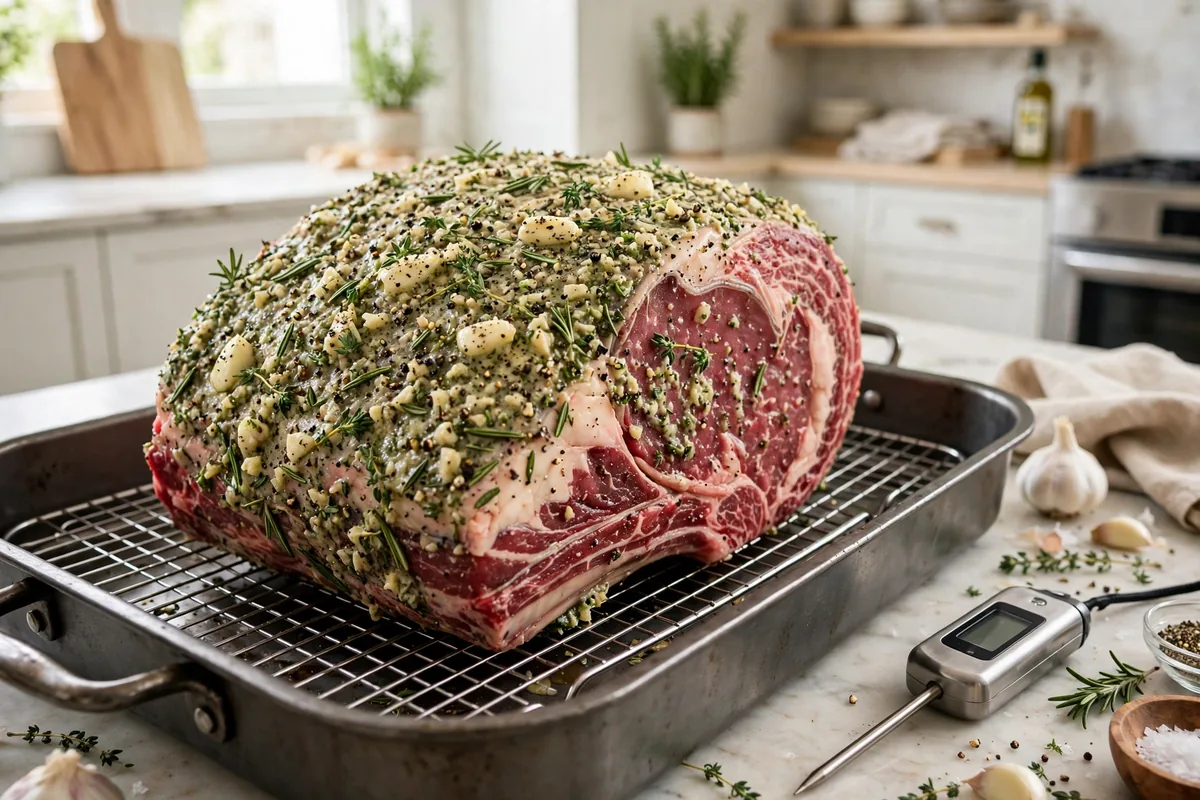
The 500-degree method (prime rib recipe 500 degrees). This is the easiest prime rib recipe there is, and it is the one for Christmas Day when the oven is busy. Take the roast out of the fridge 2 to 3 hours before cooking so it comes to room temperature. Rub it all over with the garlic herb butter below. Put it bone-side down on a rack in a roasting pan. Heat the oven to 500°F (260°C). Roast for 5 to 6 minutes per pound — a 5-pound roast takes about 25 to 30 minutes — until the crust is deep brown. Then turn the oven OFF, do not open the door, and leave the roast in the closed oven for 2 hours. The residual heat finishes the cooking gently and the roast rests at the same time. When you open the door, the roast is at medium-rare, rested and ready to carve. The only rule is the door: once it closes, it stays closed for 2 hours, or the method does not work.
The reverse sear (prime rib recipe reverse sear). This is the method for the cook who wants the most even pink from edge to edge, and it is the best prime rib recipe for a first-timer because nothing happens fast. Heat the oven low, to 250°F (120°C). Roast the rubbed prime rib slowly until a leave-in thermometer reads 120°F in the centre — about 15 to 20 minutes per pound, so a 5-pound roast takes about 1 hour 45 minutes. Take the roast out, tent it loosely with foil and rest it for 20 to 30 minutes. Then blast it in a 500°F oven for 8 to 10 minutes to build the crust. The slow roast cooks the meat evenly, the rest lets the juices settle, and the final blast gives you the crust without overcooking the middle. A prime rib roast recipe reverse sear is the method most chefs recommend, and it is the one our prime rib roast recipe walks through step by step.
How to cook prime rib in oven — the steps both methods share. First, salt the roast the night before if you can: salt draws out moisture, then dissolves and goes back in, seasoning the meat all the way through. Second, bring the roast to room temperature before it goes in — 2 to 3 hours on the counter, uncovered so the surface dries out and the crust browns better. Third, use a leave-in meat thermometer and trust it, not the clock: how to cook prime rib roast is really how to read a thermometer. Fourth, rest the roast for 20 to 30 minutes before carving — the temperature rises 5 to 10 degrees during the rest, and the juices redistribute so they stay in the meat instead of running out onto the board. And fifth, carve against the grain in thick slices, about half an inch, and serve the au jus on the side.
Prime Rib Roast Cooking Time and Temperature Chart
Prime rib roast cooking time depends on the weight, the method and the doneness you want — but the thermometer is the only thing that matters in the end. This prime rib roast cooking time chart is for a bone-in roast at 325°F, the classic prime rib roast recipe oven temperature. A boneless roast cooks about 10 to 15 minutes faster per roast, and a prime rib roast recipe slow cooker or prime rib roast recipe crock pot version cooks on low for 4 to 6 hours instead. Whatever method you use, pull the roast 5 to 10 degrees below your target: the roast rib of beef internal temperature keeps rising while it rests.
| Doneness | Pull temperature | Final temperature | Time at 325°F (per pound) |
|---|---|---|---|
| Rare | 120°F / 49°C | 125°F / 52°C | 13–15 minutes |
| Medium-rare | 125–130°F / 52–54°C | 130–135°F / 54–57°C | 15–17 minutes |
| Medium | 135°F / 57°C | 140°F / 60°C | 17–19 minutes |
| Medium-well | 140°F / 60°C | 145°F / 63°C | 19–21 minutes |
| Well done | 145°F / 63°C | 150°F / 66°C | 21–23 minutes |
For the 500-degree method, the timing is different: 5 to 6 minutes per pound at 500°F, then 2 hours in the turned-off oven. For the reverse sear, it is about 15 to 20 minutes per pound at 250°F, then a 10-minute blast at 500°F. And for a roast rib of beef cooking time in the UK, the same chart applies — but UK ovens and UK butchers quote the roast rib of beef on the bone cooking times per kilo, so a 3-kilo roast rib of beef on the bone takes about 1 hour 45 minutes at 160°C for medium-rare. Always check the centre with a thermometer: the roast rib of beef internal temperature is what decides doneness, not the clock, and a leave-in thermometer is the single best purchase for anyone learning how to cook prime rib.
The Best Prime Rib Recipe with Au Jus
This is the prime rib recipe with au jus that this whole guide is built around — the best prime rib recipe for Christmas, and the one to make if you only make one. It is a prime rib roast recipe oven method with a garlic herb butter rub, and it serves 8 to 10 people from a 4-bone roast.
Ingredients
One 4-bone prime rib roast (8 to 9 pounds), bone-in, fat cap on. For the rub: 8 tablespoons softened butter, 6 cloves of garlic minced, 2 tablespoons fresh rosemary chopped, 1 tablespoon fresh thyme leaves, 1 tablespoon coarse salt, 2 teaspoons cracked black pepper, 1 teaspoon Dijon mustard. For the au jus: the pan drippings, 2 cups of beef stock, 1 cup of red wine, 1 tablespoon of Worcestershire sauce, salt and pepper. To serve: prepared horseradish, flaky salt, and extra rosemary for the platter.
Method
1. The night before, pat the roast dry and salt it all over. Leave it uncovered in the fridge overnight — the dry surface browns better. 2. Two to three hours before cooking, take the roast out and let it come to room temperature. Mix the butter, garlic, rosemary, thyme, salt, pepper and mustard into a paste and rub it thickly over the whole roast, including the ends. 3. Heat the oven to 250°F for the reverse sear (or 500°F for the high-heat method). Set the roast bone-side down on a rack in a roasting pan and insert a leave-in thermometer into the centre, away from the bone. 4. Roast slowly at 250°F until the thermometer reads 120°F — about 1 hour 45 minutes for a 5-pound roast, a little longer for a bigger one. 5. Take the roast out, tent it loosely with foil, and rest it for 20 to 30 minutes. 6. While it rests, make the au jus: pour off the fat from the roasting pan, set the pan over medium heat, add the wine and scrape up the browned bits, then add the beef stock and Worcestershire and simmer for 10 minutes until it tastes rich. Strain and season. 7. Blast the rested roast at 500°F for 8 to 10 minutes until the crust is dark and crackling. 8. Carve against the grain in thick slices, serve with the hot au jus and horseradish, and finish with flaky salt.
The garlic herb butter is what makes this the best prime rib recipe ever for most people who try it: the butter bastes the crust as it roasts, the garlic and rosemary go dark and fragrant, and the drippings that fall into the pan become the base of the au jus. If you want a variation, add a spoonful of horseradish to the butter, or swap the thyme for sage. And if you are cooking for a crowd that includes people who like their beef more done, carve the end slices for them — the ends are always more cooked than the centre, so everyone gets the doneness they want from the same roast.
Best Prime Rib Recipe Variations
One roast, many methods. These are the best prime rib recipe variations — the ones people actually search for — and each one starts from the same garlic herb butter rub and the same thermometer.
Prime Rib Recipe Smoker
A prime rib recipe smoker version is the best prime rib recipe smoker fans will ever make: the smoke adds a flavour the oven cannot. Set the smoker to 250°F with oak or cherry wood, put the rubbed roast on the grate bone-side down, and smoke it until the centre reads 120°F — about 30 to 40 minutes per pound. Rest it, then finish it over high heat or in a 500°F oven for 10 minutes to crisp the crust. The best prime rib recipe smoker tip is to keep the smoke light: too much smoke makes the crust bitter, and prime rib needs less smoke than brisket. A prime rib roast recipe pellet grill version works the same way — how to cook prime rib on a pellet grill is the same as the smoker, because a pellet grill is a smoker with a thermostat.
Prime Rib Recipe Grill
How to cook prime rib on the grill is the question every summer cook asks, and it works for Christmas too if your grill is big enough. Set up a two-zone fire — hot on one side, cool on the other — and cook the roast on the cool side with the lid closed until it reads 120°F, then sear it over the hot side for a few minutes per side. The best prime rib recipe on the grill uses the same thermometer rule as the oven version, and the best prime rib recipe bone in works best on the grill because the bones protect the meat from the direct heat. How to cook prime rib steak is the same idea on a smaller scale: a thick ribeye steak, seared hot and rested, is a single serving of prime rib.
Prime Rib Recipe Crock Pot and Slow Cooker
A prime rib recipe crock pot version — a prime rib roast recipe crock pot or prime rib roast recipe slow cooker — is the set-and-forget option, and it is the best choice when the oven is full of turkey or ham. A prime rib roast in crock pot cooks on low for 4 to 6 hours: sear the rubbed roast in a hot pan first, then put it in the slow cooker with a cup of beef stock and cook on low until the centre reads 130°F. How to cook prime rib in a crock pot is the same: the slow cooker does the roasting, and you finish the roast under the broiler for 5 minutes to crisp the crust. The result is not as crusty as the oven version, but it is juicy, it frees the oven, and it is the easiest prime rib recipe of all — which is why "how to cook prime rib in a crock pot" is one of the most-searched prime rib questions every December.
Prime Rib Recipe Boneless and No Bone
A prime rib recipe boneless — a prime rib roast recipe boneless, or a prime rib roast recipe no bone — cooks a little faster and carves in neat, even slices, which is why it is the best choice for a buffet or a big table. Tie a boneless roast tightly with string every two inches so it holds a uniform shape, and take 10 to 15 minutes off the total cooking time. In the UK the same cut is a roast rib of beef boneless, or a roast rib of beef off the bone — ask the butcher for the bones to take home, because roasted rib bones make the best beef stock. Boneless or bone-in, the thermometer rule is the same: pull at 125°F to 130°F for medium-rare, rest, and carve.
Prime Rib Recipe 500 Degrees and Reverse Sear
The two headline methods deserve a direct comparison, because "prime rib recipe 500 degrees" and "prime rib recipe reverse sear" are the two most-searched prime rib methods. The 500-degree method is faster and simpler: 5 to 6 minutes per pound at 500°F, then 2 hours in the turned-off oven, and the roast rests itself. The reverse sear is slower and more controlled: a long, low roast at 250°F, a rest, then a short blast at 500°F for the crust. The reverse sear gives you a more even pink from edge to edge and a bigger margin for error; the 500-degree method gives you a darker crust and a free oven for two hours. Either one is the best prime rib recipe in the world if you use a thermometer — and the best prime rib recipe reddit threads agree on the same thing: the method matters less than the thermometer, the rest, and the quality of the roast.
Christmas Prime Rib Dinner Menu
A Christmas prime rib roast needs a Christmas prime rib dinner menu around it — and the sides are what turn a roast into a Christmas prime rib dinner. The classic Christmas prime rib roast menu is: the roast itself, a potato, a green vegetable, a sweet vegetable, a bread, and a sauce. A christmas standing rib roast menu is the same menu under the Australian name — the roast, the potatoes, the greens, the horseradish — and our Christmas side dishes guide has 25 make-ahead sides, but here is the menu that fits this roast best.
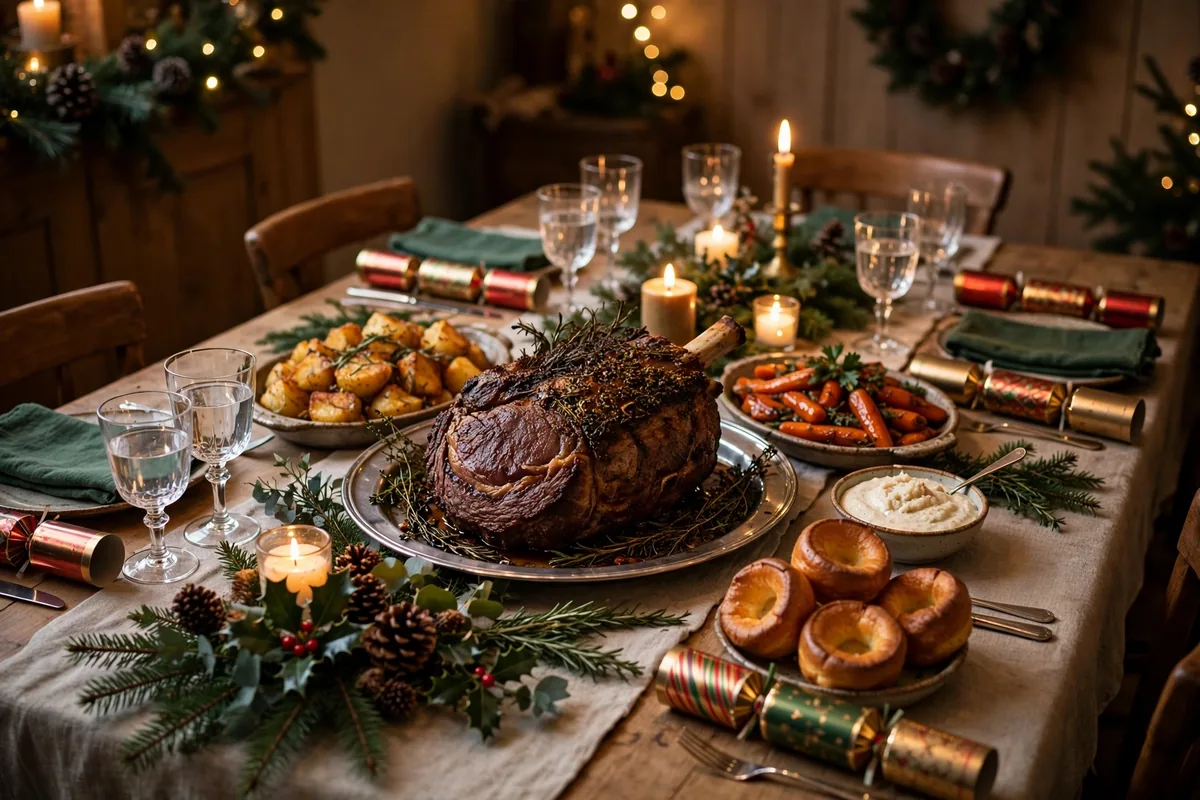
The sides. Christmas roast beef sides are the same sides that work with any Christmas roast: roast potatoes with rosemary, glazed carrots, green beans, creamed spinach, and Yorkshire puddings — which are the classic partner for a roast rib of beef in the UK. A Christmas prime rib dinner to go from a restaurant usually includes the same set: the roast, mashed potatoes, green beans and a roll. For a lighter table, swap the potatoes for a big winter salad and the Yorkshire puddings for dinner rolls. The rule is one starch, one green, one sweet, one bread — and nothing that needs the oven at the same temperature as the roast, because the roast owns the oven on Christmas Day.
The sauces. Every Christmas prime rib dinner needs two sauces on the table: au jus and horseradish. Au jus is the pan drippings thinned with beef stock and wine — the recipe is above. Horseradish is the sharp, creamy counterpoint: prepared horseradish mixed with a little sour cream, or a horseradish cream sauce. Some families add a red wine reduction or a mustard sauce, but au jus and horseradish are the pair that never fails. And the Christmas prime rib menu itself can be as simple as the roast, the two sauces, and three sides — a Christmas prime rib dinner menu does not need twelve dishes to feel like Christmas.
What about the sausage? If you searched "christmas prime rib sausage" or "christmas prime rib link sausage", here is the honest answer: there is no classic sausage made from prime rib, and most of those searches come from people looking for a sausage to serve alongside the roast, or for a Christmas prime rib sausage recipe that uses the trimmings. The best use of prime rib trimmings is not sausage — it is to render them for the roast potatoes, or to save the fat for Yorkshire pudding batter. If you want a sausage on the Christmas table, pigs in blankets are the classic, and our Christmas side dishes guide covers them.
How to Carve Prime Rib
Carving is the moment the whole table watches, and it is easier than it looks — if the roast has rested. Rest the roast for 20 to 30 minutes first: carving a roast that has not rested sends the juices running out onto the board. Then set the roast on a board with a well, or on a platter with a rim, and use a long, sharp carving knife.
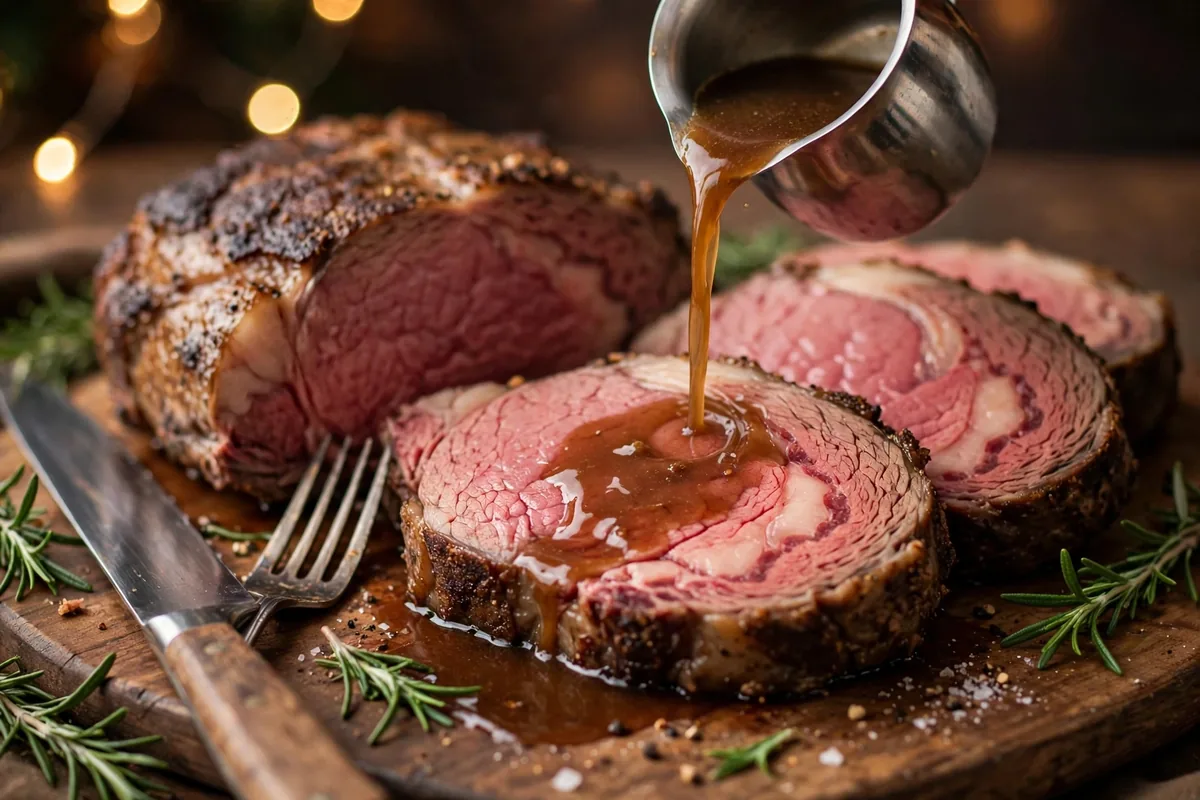
Bone-in. Stand the roast on its side with the bones facing you. Cut along the bones to free the whole eye of meat in one piece, then slice the eye against the grain into thick slices, about half an inch each. The bones go back on the platter as a second serving for anyone who wants to pick at them — and in many families, the bones are the cook's reward.
Boneless. Slice straight across the roast, against the grain, in half-inch slices. The end slices are more cooked than the centre slices, so serve the ends to anyone who likes their beef more done and the pink centre slices to the medium-rare fans. If the roast was tied, snip the strings before you slice, and keep the slices together on the platter so they stay warm. Pour a little hot au jus over the platter just before it goes to the table — it keeps the slices glossy and warm, and it is the difference between a good carving and a great one.
How to cook prime rib steaks in the oven. If you have leftover roast, or a single ribeye steak instead of a whole roast, the same method works on a small scale: sear the steak in a hot oven-proof pan, finish it in a 400°F oven until the centre reads 130°F, and rest it for 5 minutes. How to cook prime rib steak is the same as how to cook prime rib, only faster — and a thick-cut ribeye cooked this way is the best single serving of Christmas prime rib there is.
How to Store and Reheat Leftover Prime Rib
Leftover prime rib is the best leftover of Christmas, and it keeps well if you store it right. Let the roast cool, then wrap the unsliced portion tightly in foil or cling film and refrigerate it — it keeps for 3 to 4 days. Sliced leftovers keep for 2 to 3 days in an airtight container, ideally with a spoonful of au jus poured over them to keep them moist. Freeze sliced prime rib in portions with au jus for up to 3 months; thaw it overnight in the fridge.
To reheat, never use the microwave: it turns prime rib grey and tough in seconds. Instead, warm the slices gently in hot — not boiling — au jus for 2 to 3 minutes, or in a low oven at 250°F, wrapped in foil with a splash of stock, for 15 to 20 minutes. The meat should be warmed through, not cooked again. Leftover prime rib makes the best sandwiches in the world: thin slices on a crusty roll with horseradish cream, or a French dip with hot au jus for dunking. And if you have a whole leftover roast, our Christmas side dishes guide and the Leftover Magic tool can turn it into a second dinner — prime rib hash, prime rib fried rice, or a prime rib and mushroom pie.
Christmas Prime Rib Around the World
Prime rib is an American name, but the roast is cooked all over the English-speaking world — and the searches prove it. If you are cooking Christmas prime rib in the UK, Australia, Canada or New Zealand, here is what changes, and what stays the same.
Christmas Prime Rib in the UK
In the UK, nobody asks the butcher for "prime rib" — they ask for a roast rib of beef. A roast rib of beef on the bone is the Christmas centrepiece, and the UK search term is christmas roast beef: a christmas roast beef recipe, a christmas roast beef dinner, a christmas roast beef menu, and a christmas roast beef joint — a joint is the UK word for a roast. The cut is the same rib roast, from the same ribs, and the method is the same: a roast rib of beef recipe uk uses the same garlic and rosemary rub, the same low roast, and the same rest. The differences are the details: UK cooks weigh the roast in kilos, quote the roast rib of beef on the bone cooking times per kilo, and check the roast rib of beef internal temperature in Celsius — 52°C for rare, 57°C for medium-rare, 60°C for medium. The classic UK partners are Yorkshire puddings, roast potatoes and horseradish sauce, and the classic UK reference is a christmas roast beef jamie oliver recipe — Jamie Oliver's Christmas roast beef is one of the most-searched Christmas recipes in Britain — or a roast rib of beef james martin recipe, from the chef James Martin. A roast rib of beef boneless is the UK boneless version, and a roast rib of beef off the bone is the same thing: ask the butcher for the bones to take home for stock. And if you want a smaller UK roast, a christmas roast beef tenderloin — a whole beef tenderloin, the fillet — is the leaner, more expensive alternative that many British families choose instead.
Christmas Prime Rib in Australia and New Zealand
Christmas in Australia and New Zealand falls in high summer, so the Christmas prime rib there is cooked the same way but served differently. The Australian term is standing rib roast — a standing rib roast recipe oven method is the one Australian cooks search for — and the other local name is ribeye roast. A standing rib roast vs prime rib is no difference at all: the same cut, the same roast, and the same thermometer. The summer difference is the sides: instead of heavy roast potatoes and Yorkshire puddings, an Australian Christmas prime rib is served with summer salads, prawns, and cold desserts like pavlova. The roast itself is often cooked early in the morning and served at room temperature, or cooked on the barbecue — how to cook prime rib on the grill is an Australian Christmas question, because the barbecue is the summer oven. Standing rib roast cost in Australia is higher than in the US, because beef is priced differently, so many families buy a smaller roast and serve it with more sides. And the search term "standing rib roast near me" in Australia is a butcher search, the same as in the US — a good butcher, a week ahead, is the rule everywhere.
Christmas Prime Rib in Canada
In Canada, the roast is a prime rib roast — the same name as in the US — and a christmas prime rib roast dinner in Canada looks much like the American table, with tourtière on the side in Quebec and butter tarts for dessert. A standing rib roast costco search is how many Canadians find their roast: Costco's standing rib roast sale in December is one of the biggest beef sales of the year, and a standing rib roast on sale near me search in Canada usually leads to Costco or a local butcher. Standing rib roast cost in Canada runs close to US prices, a little higher in the far north, and the standing rib roast cooking time is exactly the same as the chart above — the roast does not know which country it is in. A holiday prime rib roast recipe in Canada is the same roast as a christmas standing rib roast recipe in the US, and the same garlic herb butter rub works for both. The one Canadian difference is the sides: alongside the roast potatoes and glazed carrots, a Canadian Christmas prime rib roast menu often includes maple-glazed carrots and tourtière, and the horseradish is sometimes swapped for a mustard sauce. And for the cook who wants a slow cooker option, a christmas roast beef slow cooker version — the roast cooked low in the slow cooker, then blasted under the broiler — is the Canadian answer to a full oven on Christmas Day.
Outside the five countries, the same roast shows up under other names. In Singapore, christmas roast beef singapore searches are mostly for hotel Christmas buffets and restaurant roast beef dinners — the city does not have a home-roasting tradition the way the US and UK do, but the Christmas roast beef dinner is a big restaurant event. Wherever you are cooking, the method in this guide works: the cut is the same, the thermometer is the same, and the rest is the same. Only the name on the butcher's ticket changes.
Top 5 Prime Rib Tips
Cannot decide which method to use? These are the top 5 prime rib tips from this guide — the five things that matter more than anything else, ranked by how much difference they make to the finished roast:
- Buy a thermometer, not a clock. How to cook prime rib is really how to read a thermometer. Pull at 125°F to 130°F for medium-rare and the roast will be perfect; cook by the clock and you are guessing.
- Salt it the night before. Salt draws out moisture, dissolves, and goes back in — seasoning the meat all the way through and drying the surface so the crust browns better.
- Rest it for 20 to 30 minutes. The temperature rises 5 to 10 degrees during the rest and the juices redistribute. Carve too early and the juices run out onto the board.
- Pick one method and commit. The 500-degree method or the reverse sear — both work, and the prime rib roast recipe bon appétit published uses the same reverse sear in this guide. What ruins a roast is switching methods halfway through.
- Use the bones and the drippings. The bones flavour the roast and make the best stock, and the drippings become the au jus. Nothing from a prime rib roast should be wasted — and how to cook prime rib on smoker follows the same rule, low and slow at 250°F with light smoke, then a hot finish for the crust.
If you only remember one thing, remember the thermometer. Everything else — the rub, the method, the sides — is a detail. The thermometer is the recipe.
A Christmas Prime Rib Dinner Plan for 2026
Christmas 2026 lands on a Friday, and this plan gets the roast on the table without a last-minute panic. It assumes the reverse sear method and a 4-bone roast; if you are using the 500-degree method, the roast goes in at 500°F for 30 minutes and then rests in the turned-off oven for 2 hours instead.
| When | What to do |
|---|---|
| 18–20 Dec | Order the roast from the butcher or buy the prime rib roast Costco special; check the standing rib roast sale dates |
| 24 Dec (evening) | Salt the roast all over and leave it uncovered in the fridge overnight |
| 25 Dec (morning) | Take the roast out 2 to 3 hours before cooking; rub with garlic herb butter |
| 25 Dec (midday) | Roast low at 250°F until the thermometer reads 120°F — about 1 hour 45 minutes |
| 25 Dec (afternoon) | Rest 20 to 30 minutes; make the au jus; blast at 500°F for 10 minutes |
| 25 Dec (dinner) | Carve, serve with au jus and horseradish, and enjoy the Christmas prime rib roast dinner |
The rule is simple: buy early, salt the night before, roast low, rest long, and carve at the table. A Christmas prime rib roast dinner is the easiest big Christmas dinner there is — one roast, three sides, two sauces, and the oven does almost all of the work. And if you are planning the whole Christmas meal, not just the main, our Christmas dinner ideas guide has 25 menus for every table, and our Christmas ham guide is the other classic main if you want both a ham and a roast on the table.
Christmas Prime Rib Roast — Frequently Asked Questions
How long does it take to cook a prime rib roast?
A prime rib roast takes about 15 to 20 minutes per pound at 325°F, or about 5 to 6 minutes per pound at 500°F for the high-heat method — but the clock is the wrong tool. A 5-pound bone-in prime rib roast takes roughly 1 hour 45 minutes at 325°F, while the same roast takes about 30 minutes at 500°F followed by 2 hours resting in the turned-off oven. The only reliable guide is a meat thermometer: pull the roast at 120°F for rare, 130°F for medium-rare, 135°F for medium and 145°F for medium-well, then rest it for 20 to 30 minutes before carving. The temperature rises 5 to 10 degrees while it rests.
What temperature should prime rib be cooked to?
Prime rib is best at medium-rare, which is 130°F to 135°F in the centre after resting. Pull the roast from the oven 5 to 10 degrees below your target, because the temperature keeps rising while it rests: pull at 120°F for rare (125°F final), 125°F to 130°F for medium-rare (130°F to 135°F final), 135°F for medium (140°F final) and 140°F for medium-well (145°F final). Use a leave-in meat thermometer and check the centre of the thickest part, away from the bone. Never cook prime rib past 145°F — above that temperature the fat renders out and the meat turns dry and grey.
Should I buy bone-in or boneless prime rib?
Bone-in prime rib is the better buy for Christmas: the bones insulate the meat so it cooks more evenly, they add flavour, and they make a dramatic presentation on the table. A bone-in prime rib roast recipe is also more forgiving, because the bones slow the cooking near the centre. Boneless prime rib — sold as a prime rib roast recipe no bone, or a roast rib of beef boneless in the UK — cooks a little faster, is easier to carve, and gives you more meat per pound. If you want the showpiece, buy bone-in; if you want easy carving and no waste, buy boneless. Either way, ask the butcher to cut the bones off and tie them back on: you get the flavour of bone-in and the easy carving of boneless.
How much prime rib do I need per person?
Plan on half a pound of boneless prime rib per person, or three-quarters to one pound of bone-in prime rib per person, because the bones add weight you do not eat. A 3-bone roast (about 6 to 7 pounds bone-in) serves 6 to 8 people; a 4-bone roast (about 8 to 9 pounds) serves 8 to 10. If you are feeding big eaters or want leftovers, go up one bone. Prime rib roast cost varies by grade and by store — expect roughly $15 to $25 per pound for Choice and $25 to $40 per pound for Prime at a butcher, with prime rib roast Costco prices usually at the lower end. Buy the roast a week ahead and keep it in the fridge; it keeps for 3 to 5 days.
What is prime rib called in the UK, Australia and Canada?
In the UK, prime rib is called roast rib of beef — ask your butcher for a roast rib of beef on the bone, or a fore rib of beef. The UK search term is christmas roast beef, and a christmas roast beef joint is simply the joint of beef for the Christmas table. In Australia and New Zealand it is called a standing rib roast or a ribeye roast, and it is cooked the same way for a summer Christmas. In Canada it is called a prime rib roast, the same as in the US, and prime rib roast Costco is one of the most-searched ways Canadians buy it. The cut is the same everywhere — a rib roast from ribs six to twelve — only the name changes, so whatever country you are cooking in, ask for the rib roast and cook it exactly as in this guide.