
Pavlova Recipes: The Best Easy Pavlova Recipe
Pavlova is the dessert that looks like a showstopper and eats like a cloud — a crisp meringue shell with a soft, marshmallowy centre, piled with whipped cream and fresh fruit. This guide has the best easy pavlova recipe, the one that works first time, plus the pavlova recipes every country searches for most: classic pavlova, mango pavlova, passionfruit pavlova, mini pavlovas, chocolate pavlova and Christmas pavlova. A pavlova recipe is only four ingredients — egg whites, caster sugar, cornflour and vinegar — and the whole trick is in the method: beat the egg whites to stiff peaks, add the sugar slowly until it dissolves, bake low and slow, and cool the pavlova in the oven. Get that right and the pavlova comes out white and crisp outside, marshmallow inside, every time. And because pavlova is the most popular Christmas dessert in Australia and New Zealand — where Christmas falls in high summer and the pavlova is the centrepiece of the Christmas table — this list also covers the pavlova recipes each country makes most, from the Australian pavlova with passionfruit and mango to the New Zealand pavlova with kiwifruit, the UK summer berry pavlova and the Canadian berry pavlova. If you have ever asked how to make pavlova, why your pavlova cracked, or what to put on a pavlova, start here.
What Is Pavlova?
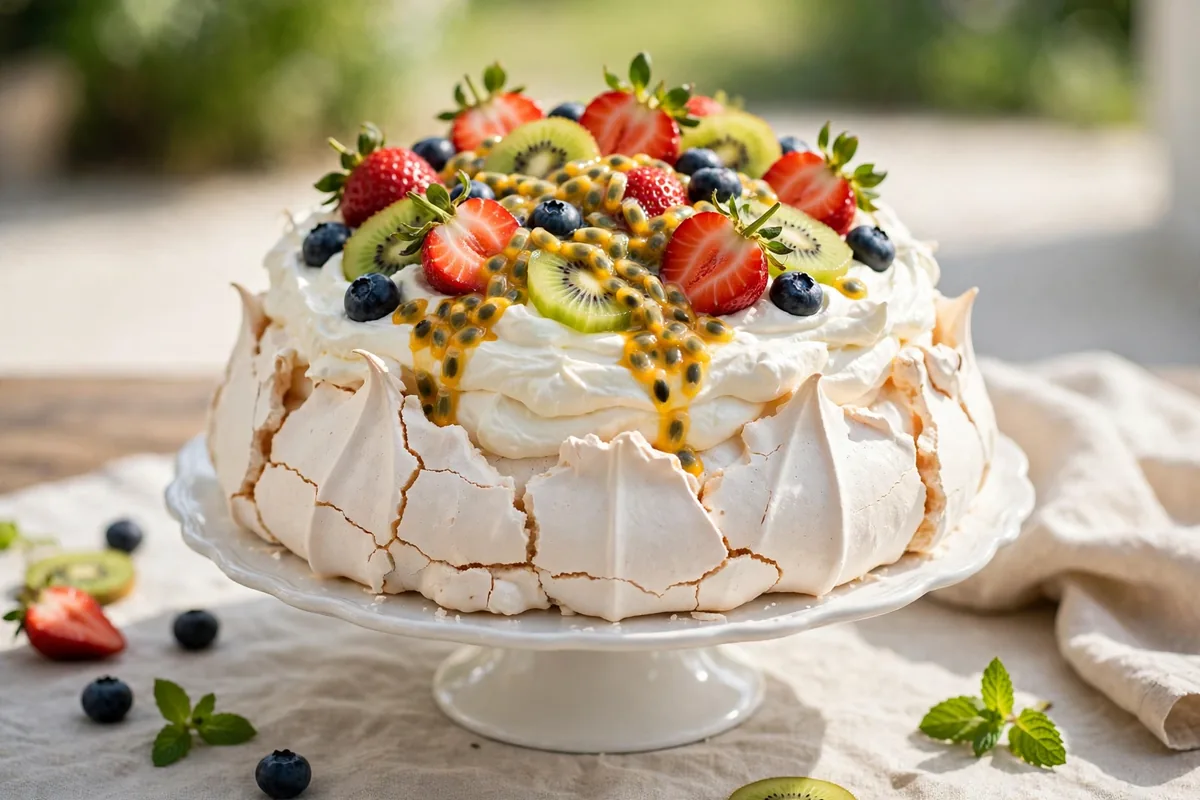
Pavlova is a meringue-based dessert named after the Russian ballerina Anna Pavlova, who toured Australia and New Zealand in the 1920s. The pavlova history and pavlova origin are disputed: Australia and New Zealand both claim the dessert, and the argument has run for almost a century. Both countries claim to have invented it — the first pavlova recipe found in print appeared in New Zealand in 1929, while the Australian claim points to Herbert "Bert" Sachse, a chef at the Esplanade Hotel in Perth, who is said to have created it in 1935. The friendly argument has run for almost a century, and neither side has given an inch, which is exactly why pavlova is the most famous dessert in both countries. What everyone agrees on is what a pavlova is: a meringue shell baked low and slow so it is crisp and dry on the outside and soft and marshmallowy in the middle, filled with whipped cream and topped with fresh fruit. That contrast — shattering shell, chewy marshmallow centre, cool cream, sharp fruit — is the whole dessert, and it is why a pavlova recipe is searched in every English-speaking country, from pavlova recipe Australia to pavlova recipe UK to pavlova recipe Canada.
Pavlova vs meringue is the question every beginner asks, and the pavlova vs meringue difference is the centre: pavlova is crisp outside and marshmallow inside, meringue is crisp all the way through. A plain meringue is baked until it is crisp and dry all the way through. A pavlova is baked at a low temperature — around 120°C / 250°F — so the outside dries into a thin crisp shell while the inside stays soft, like marshmallow. The secret is the cornflour (cornstarch) and vinegar folded into the egg whites: they stabilise the foam and keep the centre soft. Without them you get meringue; with them you get pavlova. A pavlova is also always served filled — whipped cream spooned into the well, fruit piled on top — while meringue is usually eaten on its own. And a pavlova is naturally a gluten free pavlova: egg whites, sugar, cornflour, cream and fruit, with no flour anywhere in it. Is pavlova gluten free? Yes — pavlova is naturally gluten free, because there is no flour in it. Is pavlova dairy free? The meringue shell is dairy free, but the whipped cream is not — the vegan version with coconut whip is a dairy free pavlova. What does pavlova taste like? The shell is sweet and crisp, the centre is soft like marshmallow, and the cream and fruit make it light and fresh. Pavlova dessert is the name most Americans search for, and pavlova cake is the same thing — a meringue cake topped with cream and fruit. Pavlova is the summer dessert of the southern hemisphere, and the pavlova summer dessert Australia makes is the mango pavlova at Christmas. The vegan version, made with aquafaba instead of egg whites and coconut whip instead of cream, is a dairy free pavlova too. How many calories in pavlova? The meringue shell itself is light — roughly 86 calories a serving before the cream and fruit go on — which is why pavlova is the summer dessert that feels indulgent without being heavy.
Pavlova is a Christmas dessert in the southern hemisphere and a summer dessert everywhere else. In Australia and New Zealand, Christmas falls in high summer, so the pavlova is the centrepiece of the Christmas table — made in the morning, decorated an hour before lunch, and eaten outdoors in the heat. That is why pavlova searches peak in December, January and February in Australia and New Zealand, while in the UK, Canada and the US the peak is summer: June, July and August, when berries are cheap and nobody wants to turn the oven on for long. This guide covers both seasons — the Christmas pavlova and the summer berry pavlova — because the base recipe is the same, and only the topping changes.
The Best Easy Pavlova Recipe
This is the best easy pavlova recipe because it is the simplest one that works: four ingredients for the meringue, one bowl of cream, and whatever fruit is in season. It is a foolproof pavlova recipe — the method below is the one every Australian and New Zealand test kitchen teaches, and it works first time if you follow the three rules: a spotlessly clean bowl, sugar added slowly until it dissolves, and cooling in the oven. If you are wondering how do you make pavlova, or how to make a pavlova that does not crack, this is the method. This pavlova recipe serves 8 to 10 people, takes about 20 minutes of hands-on work plus 1 hour 30 minutes in the oven, and the shell can be made 1 to 2 days ahead. Pavlova serves how many? One classic pavlova serves 8 to 10 people, and one batch of mini pavlovas serves 6 to 8. Pavlova how many servings? One classic pavlova is 8 to 10 servings. This is a simple pavlova recipe and a pavlova recipe for beginners — four ingredients, one bowl, and three rules. Use whipping cream or heavy cream for the filling: 1½ cups of whipping cream whipped with 2 tablespoons of icing sugar and 1 teaspoon of vanilla. If you need a pavlova without cornflour, replace the 1 teaspoon of cornflour with 1 teaspoon of cream of tartar. And this recipe has no cream of tartar in it by default — the vinegar does the same job, so a pavlova without cream of tartar is the normal pavlova.
Pavlova Ingredients
For the meringue shell you need 4 large egg whites (about 120 g / ½ cup), at room temperature; 1 cup (200 g) caster sugar — also called superfine sugar, and in the US sometimes sold as baker's sugar; 1 teaspoon cornflour, also called cornstarch; and 1 teaspoon white vinegar (white wine vinegar or lemon juice work the same way). For the topping you need 1½ cups (375 ml) thickened cream — heavy cream in the US, double cream in the UK — 1 tablespoon icing sugar (confectioners' sugar or powdered sugar), 1 teaspoon vanilla extract (vanilla essence), and about 2 cups of fresh fruit: strawberries, raspberries, blueberries, kiwi fruit, mango and passionfruit, or whatever is ripe. If you are scaling the recipe up for a crowd, our Recipe Scaler tool will work out the egg white and sugar quantities for you — the ratio to remember is ¼ cup of egg whites to ½ cup of sugar to 1 teaspoon of cornflour to ½ teaspoon of cream of tartar, and you can scale from there.
How to Make Pavlova — Step by Step
First, clean your equipment: the smallest trace of fat or grease stops egg whites from whipping, so wash the bowl and whisk in hot soapy water, rinse, dry well, and rub a slice of lemon over them as a final clean. Separate the eggs while they are cold — the yolks come away more cleanly — then let the whites come to room temperature, because room-temperature whites whip to more volume. Measure the whites if you can: egg sizes vary so much that volume is more reliable than counting eggs, and 120 g (½ cup) is the amount for this recipe.
Preheat the oven to 150°C / 300°F and line a baking tray with baking paper. Draw a 20 cm (8-inch) circle on the paper with a pencil, then flip the paper over so the pencil mark is underneath. Beat the egg whites on medium speed until soft peaks form — the peaks should droop gently when you lift the whisk. Then add the caster sugar one tablespoon at a time, waiting about 15 seconds between additions, beating until the meringue is thick, glossy and holds stiff peaks. Rub a little between your fingers: it should feel smooth, not gritty. If it feels gritty, the sugar has not dissolved — keep beating, because undissolved sugar is the main cause of a pavlova weeping syrup later. Sift the cornflour over the meringue, drizzle in the vinegar, and fold both in gently with a spatula. Do not beat them in — folding keeps the air in.
Spoon the meringue inside the circle and shape it into a round with a shallow well in the centre and raised edges — the well holds the cream, and the raised edges stop the centre from splitting as it settles. Put the tray in the oven and immediately turn the temperature down to 120°C / 250°F. How long to bake pavlova? Bake for 1 hour 30 minutes without opening the oven door. The shell should look dry and matte and feel firm at the rim. Then turn the oven off and leave the pavlova inside with the door closed for at least 1 hour — overnight is even better. This slow cooling is what stops the pavlova cracking and collapsing: a sudden rush of cold air makes the shell contract and the centre sink. When the shell is completely cold, peel away the paper and move it to a serving plate. Whip the cream with the icing sugar and vanilla until soft peaks form, spoon it into the well, and top with the fruit. Serve immediately — a filled pavlova should be eaten within 4 hours, because the cream softens the shell.
That is the whole method, and it is the base for every pavlova recipe in this guide. The ten pavlova recipes below all start from this same meringue — only the topping, the shape or one flavour changes. If you can make this one, you can make all ten.
10 Pavlova Recipes
Here are the ten pavlova recipes worth making — the classic first, then the variations each country searches for most: mango pavlova, passionfruit pavlova, mini pavlovas, chocolate pavlova, Christmas pavlova, and the topping-led versions. Every one of these pavlova recipes uses the same meringue base from the recipe above, so the only new thing in each is the topping or the shape. If you want a pavlova recipe easy enough for a first attempt, start with number 1; if you want the pavlova recipe Australia makes at Christmas, go to number 2; and if you are feeding a crowd, number 4 is the one.
1. Classic Pavlova with Berries
The classic pavlova recipe is the one every other pavlova recipe is measured against: a crisp meringue shell, softly whipped cream, and fresh berries. Make the meringue base from the recipe above, whip 1½ cups of thickened cream with 1 tablespoon of icing sugar and 1 teaspoon of vanilla, and pile it into the well. Top with strawberries, raspberries and blueberries — about 2 cups in total — and a few mint leaves if you like. This is the best pavlova recipe for a first attempt, because the berries do the decorating for you, and it is the classic pavlova recipe the UK makes most: Mary Berry's pavlova recipe is this exact combination, and it is the summer berry pavlova that shows up at every British garden party. In the US, this is the pavlova recipe King Arthur Baking and Once Upon a Chef publish first, and it is the one most American cooks mean when they search "pavlova recipe" with no country attached. The berries should be dry — pat them with a tea towel — because wet fruit makes the cream slide and the shell soften faster.
2. Mango Pavlova
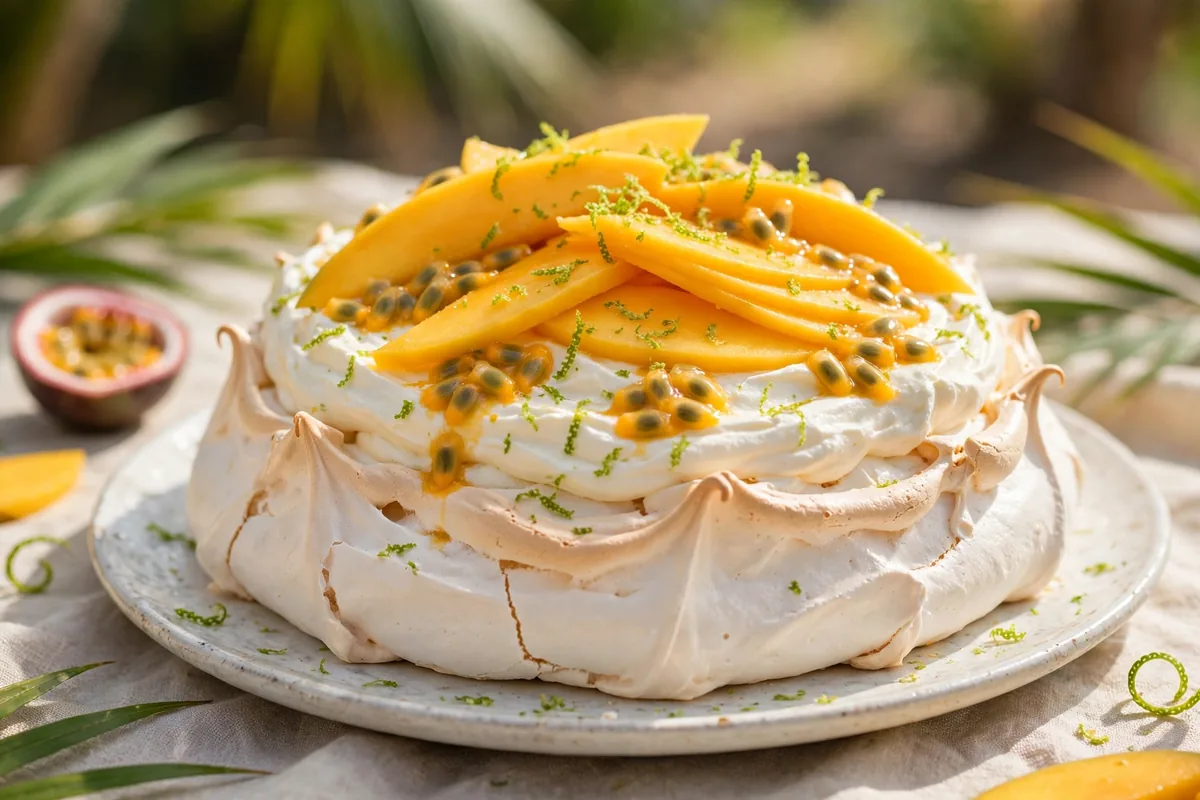
Mango pavlova is the Australian summer pavlova — the one that tastes like a Queensland December. A mango pavlova Australia makes is the Christmas one: mango, passionfruit and lime zest on a classic shell. A mango pavlova New Zealand makes is the same mango and passionfruit. A pavlova with mango Australia style uses Alphonso or Kensington Pride mango, a pavlova with passionfruit Australia style is the classic passionfruit pulp over cream, a pavlova with passionfruit New Zealand style adds kiwifruit, and a pavlova with berries Australia style is the January version with mixed berries. Make the meringue base, whip the cream, and top it with 2 ripe mangoes, peeled and thinly sliced, plus the pulp of 2 passionfruit and a little lime zest. For the full version, make a mango curd while the pavlova bakes: blend 2 mangoes with the zest and juice of 1 lime and 150 g of caster sugar, pour it into a pan with 6 egg yolks and 115 g of cold butter, and cook on low heat, stirring, for 4 to 5 minutes until it thickens. The mango curd keeps for 3 days in the fridge, and it turns a good mango pavlova into a great one — the tart curd cuts the sweetness of the meringue. A mango pavlova recipe is also the most-searched tropical pavlova in New Zealand, where the version from VJ Cooks layers two rectangular meringues with toasted coconut, lime zest and white chocolate. If you want a mango pavlova with mango curd, the sheet-style version from Gather and Feast is the one to follow: same base, same curd, spread on a rectangle instead of a round. Mango pavlova is best in summer, when mangoes are ripe and cheap — in Australia that is December to February, which is exactly when the pavlova searches peak.
3. Passionfruit Pavlova
Passionfruit pavlova is the pavlova most Australians would call the real one. Passionfruit — the tart, seedy, golden pulp — is the topping that belongs on a pavlova more than any other fruit, and a pavlova with passionfruit is the combination every Australian and New Zealand cook grows up with. Make the meringue base, whip the cream, and spoon the pulp of 4 to 6 ripe passionfruit over the top, letting it drip down the sides. For the full passionfruit pavlova recipe, make a passionfruit curd: whisk 6 egg yolks with the juice of 1 lemon, heat 1 cup of passionfruit pulp with 6 tablespoons of superfine sugar until the sugar dissolves, then whisk the two together over a double boiler with 1 teaspoon of cornstarch and 6 tablespoons of butter until thick. Layer it between two meringue rounds with whipped cream, as in the Tasting Table version, or spoon it over a single shell. Alton Brown's pavlova with passion fruit topping is the American version of the same idea — 4 passion fruit, whipped cream, and a meringue baked at 250°F. Passionfruit pavlova is also the pavlova topping that keeps best: the acidity of the fruit cuts the sweetness of the meringue, so the whole dessert tastes balanced instead of just sweet. If fresh passionfruit is hard to find, use passionfruit juice with a squeeze of lemon — the flavour is the same, and the curd sets the same way.
4. Mini Pavlovas
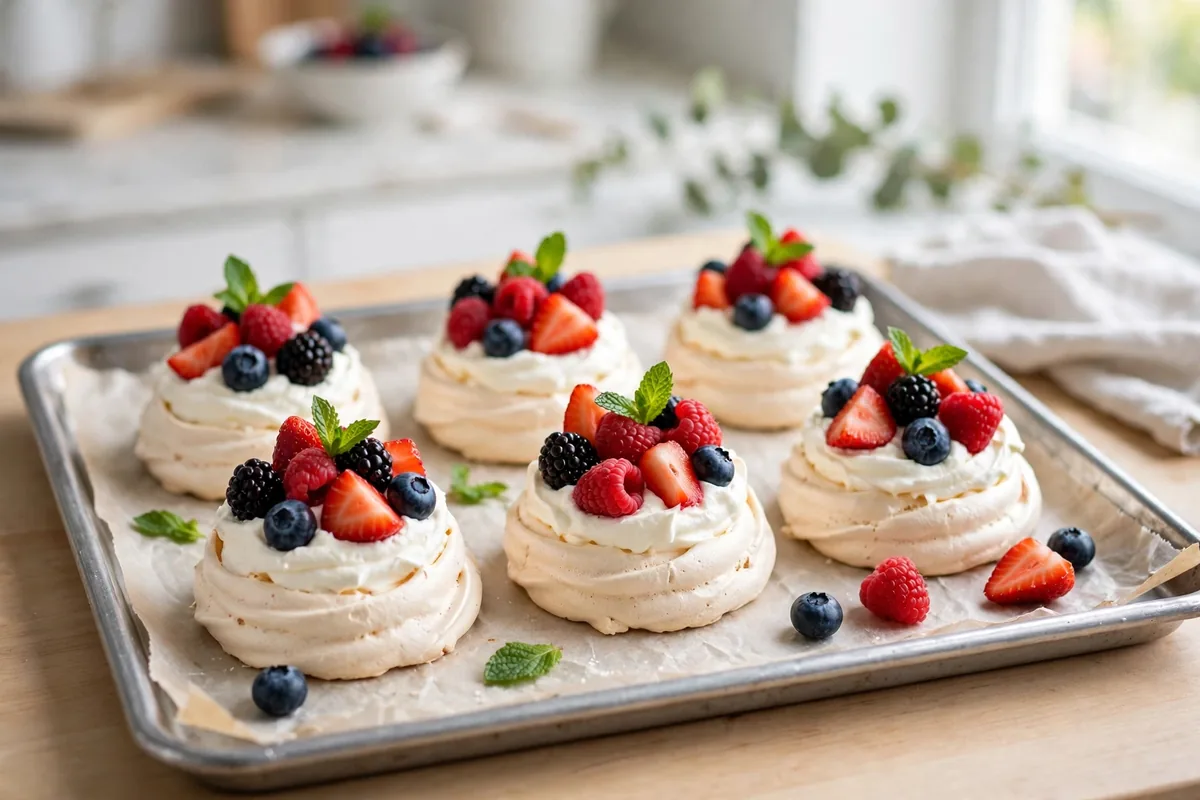
Mini pavlovas are the pavlova recipe for a crowd — one little meringue nest per person, no slicing, no sharing, no arguments about who gets the biggest piece. Each nest is an individual pavlova, and that is the point: everyone gets their own. Mini pavlova nests can be made 1 to 2 days ahead and filled an hour before serving. A mini pavlova with berries is the simplest filling: cream and mixed berries. A mini pavlova Christmas version uses cranberries and pomegranate. A single serve pavlova is the same as a mini pavlova — one nest per person — and a pavlova for dinner party serving is the mini pavlova, one nest per guest. Make the same meringue, then spoon or pipe it into 6 to 8 small nests, each about 3½ inches wide, with a hollow in the centre made with the back of a spoon. Bake at 225°F (110°C) for 60 minutes, then turn the oven off and let them cool completely inside, at least 1 to 2 hours, or overnight. The mini pavlova recipe from Tastes Better From Scratch makes 6, the Joy of Baking version makes 8, and the Weight Watchers Canada version makes 16 small ones. Fill each nest with whipped cream just before serving and top with berries, diced mango, passionfruit pulp, kiwi or pineapple — the topping ideas are the same as for a large pavlova, just smaller. Mini pavlovas are also the best pavlova recipe for a dinner party, because you can fill them at the table and everyone gets their own, and they are the best pavlova for kids, because a small nest is easier to hold than a slice. A mini pavlova with mascarpone cream is the fancier version: whip mascarpone with the cream for a thicker, tangier filling. The meringue nests keep for 2 days in an airtight container, so you can bake them ahead and fill them on the day.
5. Chocolate Pavlova
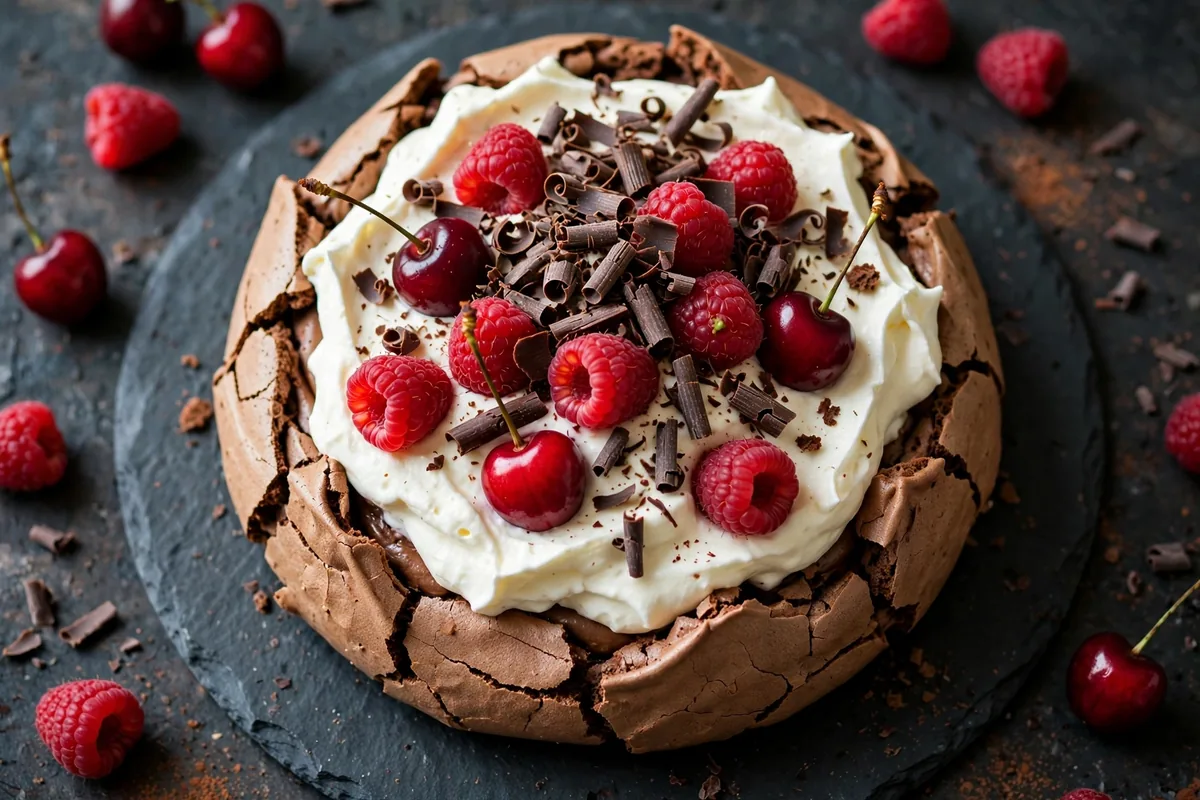
This chocolate pavlova recipe is the pavlova recipe for people who think meringue is too sweet on its own. Fold 2 tablespoons of unsweetened cocoa powder and 1 ounce (30 g) of finely chopped dark chocolate into the meringue after the sugar is dissolved — sift the cocoa and cornstarch over the top and fold gently so you do not knock the air out. The cocoa turns the shell a pale brown and gives the marshmallow centre a chocolate flavour, and the chopped chocolate melts into little pockets inside. Bake the same way, low and slow, and top with whipped cream, fresh berries and chocolate shavings. A chocolate pavlova with berries is the classic finish: whipped cream, fresh berries and chocolate shavings on a cocoa shell. The Smitten Kitchen chocolate pavlova — adapted from Nigella Lawson's chocolate pavlova — uses ¼ cup of cocoa and 2 ounces of chopped bittersweet chocolate, which makes it a double chocolate pavlova, and it is the version most American cooks make. The chocolate pavlova Nigella Lawson made famous, and the chocolate pavlova Smitten Kitchen adapted from it, are the same recipe — cocoa in the meringue, berries and chocolate shavings on top. The Joy of Baking chocolate pavlova is the same idea with a 7-inch round and a 60 to 75 minute bake. A chocolate swirl pavlova is the Canadian variation: swirl melted chocolate through the meringue with a toothpick before baking, then fill with Nutella, whipped cream and berries. Chocolate pavlova is also the best pavlova for winter, when berries are expensive and chocolate is the point — it is the pavlova that works at Christmas in the northern hemisphere, when a plain pavlova can feel too summery.
6. Christmas Pavlova
Christmas pavlova is the pavlova Australia and New Zealand eat on Christmas Day — and the one the UK is starting to make too. This Christmas pavlova recipe works in any country. There are two famous versions. The first is a Christmas pavlova with berries, cranberries and pomegranate: make the classic shell, whip the cream, and top it with fresh raspberries, blueberries and pomegranate arils — red, white and green, the colours of Christmas, and the tart fruit cuts the sweet meringue. A Christmas pavlova with pomegranate is the version most UK cooks make in December, and it is the Christmas pavlova UK cooks search for most. The second is the pavlova Christmas tree from RecipeTin Eats: bake the meringue in three different-sized rounds, stack them with cream and raspberry coulis between the layers, scatter diced strawberries between the layers, and decorate with raspberries, rosemary sprigs and icing sugar, with a star on top. It serves 12 to 16 and it is the grandest pavlova of all. A Christmas pavlova wreath is the simpler version: pipe the meringue in a ring of dollops, bake, and fill the ring with cream and berries. The pavlova Christmas tree Australia makes is the RecipeTin Eats one, and the pavlova wreath Australia makes for Christmas is the ring version. Pavlova for Christmas is the dessert of the southern hemisphere summer, and the pavlova Christmas dessert is the one every Australian and New Zealand family makes. Pavlova Christmas Australia and pavlova Christmas New Zealand are the same thing: the summer Christmas pavlova, and a pavlova New Zealand Christmas table has the classic pavlova with kiwifruit, strawberries and passionfruit. In the US, the Christmas pavlova from Taste of Home adds sprinkles to the meringue and a cranberry-orange topping. Whatever shape you choose, the rule for a Christmas pavlova is the same as for any pavlova: bake the shell a day or two ahead, decorate an hour before serving, and eat it the same day.
7. Pavlova with Lemon Curd
Pavlova with lemon curd is the pavlova for people who find meringue too sweet. The lemon curd — sharp, buttery, yellow — does what passionfruit does: it cuts the sweetness and gives the dessert a second flavour. Make the meringue base, then make the curd: whisk 4 egg yolks with 100 g of sugar and the juice of 2 lemons, cook on low heat with 50 g of butter until it thickens, and cool it. Spoon the curd into the well first, then the whipped cream, then the berries. A lemon pavlova is also the base for a citrus pavlova: add lemon zest to the cream, top with orange segments and passionfruit, and you have the citrus pavlova with passionfruit that shows up in the topping lists. Lemon curd keeps for a week in the fridge, so you can make it days ahead, and it is the topping to use when the fruit in the shops is dull — the curd carries the flavour on its own.
8. Berry Pavlova with Mascarpone
Berry pavlova with mascarpone is the pavlova for a dinner party — richer, thicker and more stable than plain whipped cream. Whip 250 g of mascarpone with 1 cup of thickened cream, 2 tablespoons of caster sugar and 1 teaspoon of vanilla until it holds soft peaks, and use it instead of plain cream. The mascarpone makes the filling hold its shape for longer, which matters if the pavlova has to sit on the table for an hour before it is cut. Top with mixed berries — strawberries, raspberries, blueberries and blackberries — and a few mint leaves. A pavlova with mascarpone cream is also the version to make in hot weather: plain whipped cream softens fast in the heat, and mascarpone holds up better. The same filling works for mini pavlovas, and it is the filling in the mini pavlova with mascarpone cream recipe from Goldsteig. If you want a cheesecake-inspired pavlova, this is it — the mascarpone gives it that tangy, creamy edge without turning it into a cheesecake.
9. Tropical Pavlova
Tropical pavlova is the pavlova Australia makes when the stone fruit is gone and the mangoes are in. Make the meringue base, whip the cream, and top it with mango, pineapple, passionfruit and toasted coconut flakes — the tropical paradise combination. A tropical pavlova with pineapple and coconut is the same idea with a different balance: diced pineapple, toasted coconut shavings and a little lime zest. The vegan tropical passionfruit and mango pavlova from VegNews uses aquafaba instead of egg whites and coconut whip instead of cream, and it is the version to make for a dairy-free table — aquafaba whips into peaks just like egg whites, 2 tablespoons for each egg white. A pavlova with pineapple, pawpaw and guava is the Queensland version, and it is the topping combination that shows up in the Australian pavlova topping lists more than any other after berries. Tropical pavlova is best eaten the day it is made: pineapple juice softens the shell faster than berries do, so assemble it as late as you can.
10. Pavlova with Kiwifruit
Pavlova with kiwifruit is the New Zealand pavlova — the one every Kiwi grows up with. Make the meringue base, whip the cream, and top it with sliced kiwifruit, strawberries and passionfruit pulp. The RNZ pavlova recipe uses 4 kiwifruit and 4 passionfruit on 600 ml of whipped cream, and the New Zealand Woman's Weekly version adds bananas and strawberries to the same combination. Kiwifruit is the fruit that makes a pavlova taste like New Zealand: sharp, green, and cheap in December, when it is in season. A pavlova with kiwi and passionfruit is also the topping combination that shows up in the New Zealand pavlova lists first, ahead of berries. If you want the full Kiwi version, crumble hokey pokey — honeycomb toffee — over the top: it is the crunchy topping that New Zealand pavlova is known for, and it is the one topping no other country's pavlova has. Serve a pavlova with kiwifruit in summer, when the fruit is ripe and the pavlova is at its best — and if you are in New Zealand at Christmas, this is the pavlova on the table.
Pavlova Toppings
The best pavlova toppings are the ones that balance the meringue: something creamy, something sharp, and something fresh. The cream is the base — whipped cream, mascarpone cream, or Greek yogurt for a lighter version — and the fruit is the point. Here are the topping combinations that work, from the classic to the creative, and what each one is best for. What fruit goes on pavlova? Almost any soft fruit works: berries, mango, passionfruit, kiwifruit, stone fruit, and citrus. What to put on pavlova is a matter of taste — the classic is cream and fruit, but a strawberry pavlova with sliced strawberries, a mixed berry pavlova with raspberries, blueberries and blackberries, a pavlova with raspberries, or a pavlova with strawberries are all classic. A mango and passionfruit pavlova is the Australian summer version, and a tropical mango pavlova adds lime zest. A vegan pavlova uses aquafaba instead of egg whites — pavlova aquafaba is the egg-free version, made with the liquid from a can of chickpeas — and coconut whip instead of cream. Pavlova passionfruit curd is the tangy layer under the cream: spread lemon curd or passionfruit curd on the shell before the cream. A passion fruit pavlova is the same as a passionfruit pavlova — passion fruit and passionfruit are the same fruit, spelled two ways — and a pavlova with passion fruit and raspberries is the classic: passion fruit pulp and fresh raspberries over cream. Other pavlova toppings: a pavlova with cream cheese (fold cream cheese into the cream for a cheesecake flavour), a pavlova with caramel (drizzle salted caramel over the cream), a pavlova with chocolate ganache (spoon ganache over the cream before the fruit), and a pavlova with coconut (toast coconut flakes over the top).
The classic pavlova topping is whipped cream and fresh berries: strawberries, raspberries and blueberries, with a little icing sugar dusted over the top. It is the topping most people mean when they say "pavlova toppings", and it is the one to make first. The tropical pavlova topping is mango, pineapple and passionfruit with toasted coconut flakes — the combination Australia makes at Christmas. The New Zealand pavlova topping is kiwifruit, strawberries and passionfruit, with hokey pokey crumbled over it. The chocolate pavlova topping is chocolate ganache, fresh berries and chocolate shavings — drizzle the ganache over the cream and scatter the berries on top. The lemon pavlova topping is lemon curd and berries: spoon the curd into the well first, then the cream, then the berries. The caramel pavlova topping is salted caramel sauce and bananas, with toasted nuts for crunch. The autumn pavlova topping is spiced pears or apples with cinnamon — the one to make when berries are out of season. And the festive pavlova topping is cranberries, pomegranate and rosemary — the Christmas combination.
Other pavlova topping ideas worth trying: fig, honey and pistachio; rhubarb and custard; salted caramel and bananas; Nutella and strawberries; coffee and mascarpone for a mocha pavlova; and edible flowers for a pavlova that has to look as good as it tastes. The rule for any topping is the same: the fruit should be dry, the cream should be softly whipped (not stiff, or it will crack the shell when you cut it), and the pavlova should be filled as late as possible — no more than an hour before serving. If you want pavlova toppings without cream, Greek yogurt, coconut whip, mascarpone, pastry cream or lemon curd all work on their own: yogurt is the lightest, coconut whip is the best dairy-free option, and mascarpone is the richest.
Pavlova Troubleshooting
Pavlova has a reputation for being difficult, but almost every pavlova problem has one cause and one fix. Here is the pavlova recipe troubleshooting guide — the problems people search for most: why pavlova cracks, why it collapses, why it weeps — and what to do about each one.
Why did my pavlova crack? Some cracking is normal: the shell dries and contracts around a softer centre, so fine cracks are expected and even desirable. Large structural cracks mean the oven was too hot, the pavlova cooled too fast, or the meringue was unstable. Fix it by baking lower — around 120°C / 250°F once the pavlova is in the oven — and cooling slowly in the switched-off oven. Never open the oven door while it bakes, and shape a shallow well in the centre so it can settle without splitting. How to fix cracked pavlova? You cannot un-crack the shell, but you can hide the cracks — spoon the cream over them and pile the fruit on top, and nobody will see them.
Why did my pavlova collapse? A slight settling in the centre is normal. A dramatic collapse usually means the meringue was not stable enough, the sugar did not dissolve, the pavlova was underbaked, or it cooled too suddenly. Overwhipped egg whites also make a weak structure — stop at glossy firm peaks, not dry granular foam. Fix it by beating the sugar in slowly until it feels smooth between your fingers, baking for the full 1 hour 30 minutes, and cooling in the oven for at least an hour. Why did my pavlova go flat? The same three causes: under-beaten whites, sugar added too fast, or an oven that was too hot. Why is my pavlova chewy? The shell was underbaked, or the air was humid — bake it the full time and cool it in the oven. Pavlova in humid weather is the hardest pavlova to make: humidity makes the shell sticky and soft, so bake on a dry day if you can, and store the shell in an airtight container.
Why is my pavlova weeping? Weeping — beads of syrup on the surface — means the sugar did not dissolve properly during mixing. Undissolved sugar attracts moisture during baking, and the syrup seeps out. Fix it by adding the sugar one tablespoon at a time and beating until it dissolves after each addition, and by rubbing a little meringue between your fingers to check: if it feels gritty, keep beating.
Why is my pavlova sticky? Pavlova is hygroscopic — it absorbs moisture from the air — so humidity is the enemy. A sticky pavlova was almost always made on a humid day, or stored in the fridge, which makes it soft and tacky. Fix it by making pavlova on a dry day, baking 15 minutes longer in humid weather, and storing the shell in an airtight container in a cool, dry place, never the fridge. The old New Zealand advice is blunt and true: if it looks like rain, do not make pavlova that day.
Why is my pavlova flat? Too much air in the meringue makes it rise fast and then fall, and cooling too quickly makes the inside shrink and pull the shell down. Fix it by mixing on medium-low speed the whole time — a high speed incorporates too much air — and by letting the pavlova dry out in the oven after baking, for at least 1 to 2 hours, or overnight.
Why did my pavlova brown? Browning is a temperature problem: if the oven is above 250°F / 120°C once the pavlova is baking, the outside browns. Fix it by dropping the temperature 25 degrees and using an oven thermometer, because many ovens run hotter than the dial says. A pale pavlova is a good pavlova — the shell should stay white or very pale cream.
Why won't my egg whites whip? A dirty bowl, a dirty whisk, or oil from your hands is almost always the cause. Even a trace of yolk stops the whites from foaming. Fix it by washing the bowl and whisk in hot soapy water, drying them completely, and wiping them with lemon juice. Separate the eggs while they are cold, when the yolks are firmest, and keep every drop of yolk out of the whites.
How to Store and Freeze Pavlova
How long a pavlova lasts depends on whether it is filled. The shell and the filling have different rules, and mixing them up is the most common pavlova mistake. Here is how long each part keeps and how to store it:
| Part | Keeps for | How to store |
|---|---|---|
| Unfilled meringue shell | 2–3 days | Airtight container, cool dry place, never the fridge |
| Filled pavlova (cream + fruit) | Eat within 4 hours; 1 day in the fridge | Refrigerate; the shell softens after 4 hours |
| Whipped cream (on its own) | 2–3 days fridge | Airtight container, refrigerate |
| Mascarpone cream | 2 days fridge | Airtight container, refrigerate |
| Lemon curd / passionfruit curd | 1 week fridge; 3 days for mango curd | Airtight jar, refrigerate |
| Mini pavlova shells | 2 days | Airtight container, cool dry place |
| Frozen pavlova | Do not freeze | Freezing splits the meringue and makes it weep |
Can you freeze pavlova? No — do not freeze pavlova. The meringue splits and weeps when it thaws, and the texture is ruined. Can you make pavlova ahead? Yes — that is the best way to do it: bake the shell 1 to 2 days ahead, store it in an airtight container, make the cream ahead too, and assemble an hour before serving. Can pavlova be made the day before? Yes — the shell is at its best 1 to 2 days after baking, as long as it is kept dry. How to store pavlova? Keep the shell in an airtight container in a cool, dry place, the cream in the fridge, and bring them together at the last minute. Pavlova make ahead and pavlova storage are simple: bake the shell 1 to 2 days ahead and store it in an airtight container, and the cream keeps 2 to 3 days in the fridge. How to keep pavlova crisp? Assemble it as late as possible, keep the fruit dry, and never put the unfilled shell in the fridge. Can you refrigerate pavlova? The filled pavlova, yes, for 1 day — but the shell goes soft. The unfilled shell, no — the fridge makes it sticky. Store the shell at room temperature, the cream in the fridge, and bring them together at the last minute.
Pavlova Recipes Around the World
Pavlova is a question in every country — and the answers are different everywhere. If you are cooking pavlova in Australia, New Zealand, the UK or Canada, here are the pavlova recipes each country looks for most, and how they fit into this list.
Pavlova in Australia
Australian pavlova is the summer Christmas pavlova: a tall meringue shell topped with whipped cream, passionfruit, mango and berries, eaten outdoors on Christmas Day. The Australian Christmas pavlova is the mango pavlova at Christmas and the classic berry pavlova in January, and both use the same base. The classic Aussie pavlova recipe — the one from RecipeTin Eats and the Australian Women's Weekly — uses 150 ml of egg whites, 1 cup of caster sugar, 1 tablespoon of cornflour and 1 teaspoon of white vinegar, baked at 115°C fan-forced for 1½ hours and cooled in the oven overnight. The Australian pavlova is shaped into a dome, not a flat cake, and it is topped with whatever fruit is ripe: passionfruit and mango in December, berries in January. The pavlova recipe Australian families make is the same one: 150 ml of egg whites, 1 cup of caster sugar, 1 tablespoon of cornflour and 1 teaspoon of white vinegar. The heat and humidity warning matters here more than anywhere: pavlova is a summer dessert, but hot humid weather makes it collapse, so Australian recipes add extra tips for baking on a 33°C day — measure the egg whites by volume, beat the sugar in slowly, and never open the oven door. If you are in Australia, start with the mango pavlova in recipe 2 and the classic pavlova in recipe 1 — those are the two Australian pavlovas everyone makes.
Pavlova in New Zealand
New Zealand pavlova is the Kiwi pavlova: the same meringue shell, topped with kiwifruit, strawberries and passionfruit, sometimes with hokey pokey crumbled over the top. The first pavlova recipe found in print appeared in New Zealand in 1929, and New Zealanders have claimed the dessert ever since. The New Zealand pavlova recipe — the fail-safe pavlova from the Otago Daily Times, the RNZ recipe, the New Zealand Woman's Weekly version — uses 4 egg whites, 1 cup of caster sugar, 1 teaspoon of white vinegar and 1 tablespoon of cornflour, baked at 120°C to 150°C and cooled in the oven. The pavlova recipe New Zealand cooks make is the classic one with kiwifruit, strawberries and passionfruit — the pavlova recipe NZ families pass down is the one from the Edmonds Cookery Book. The pavlova kiwifruit topping is the classic: sliced kiwifruit over cream. A pavlova kiwi classic is the Edmonds one with kiwifruit, strawberries and passionfruit, and a pavlova with kiwi fruit is the New Zealand pavlova. A pavlova hokey pokey version crumbles hokey pokey (honeycomb toffee) over the cream. The Kiwi pavlova is often made as an all-in-one pavlova: all the ingredients go in the bowl at once and the mixer does the work, a method from the 1970s when electric beaters became common. If you are in New Zealand, start with the pavlova with kiwifruit in recipe 10 and the passionfruit pavlova in recipe 3 — those are the two Kiwi pavlovas, and the hokey pokey on top is the detail that makes it New Zealand.
Pavlova in the UK
British pavlova is the summer berry pavlova: a meringue shell topped with double cream and fresh summer berries, eaten at garden parties and barbecues. The Mary Berry pavlova recipe — 4 egg whites, 225 g of caster sugar, 2 teaspoons of cornflour and 2 teaspoons of white wine vinegar, baked for about an hour at 160°C and cooled in the oven — is the easy pavlova recipe UK cooks make most, and the Jamie Oliver pavlova is the same base with a 20 cm circle and a 1-hour bake at 120°C. The Sainsbury's pavlova and the Tesco pavlova are the supermarket versions of the same recipe, and the Arla pavlova is the Danish take with double cream and berries. The pavlova summer berry UK version is the one with double cream and fresh berries, and a pavlova with double cream UK style is the summer berry pavlova. A pavlova for Christmas UK style is the cranberry and pomegranate version. In the UK, pavlova is a summer dessert first and a Christmas dessert second: the summer berry pavlova in June and July, and a Christmas pavlova with cranberries and pomegranate in December. If you are in the UK, start with the classic pavlova in recipe 1 and the Christmas pavlova in recipe 6 — those are the two British pavlovas.
Pavlova in Canada
Canadian pavlova is the classic berry pavlova: a meringue shell topped with whipped cream and mixed berries, made with the Anna Olson method that the Busy Baker adapted. The BC Egg pavlova — 4 egg whites, 1 cup of sugar, 1 teaspoon of cream of tartar, 1 teaspoon of vanilla, 1 teaspoon of cornstarch and 1 teaspoon of vinegar, baked at 300°F for about an hour — is the Canadian farm version, and the Parents Canada pavlova is the same base with icing sugar and pistachios. The pavlova recipe Canadian cooks make most is the Anna Olson one. Pavlova Canada is a smaller story than pavlova Australia, but the classic berry pavlova is the one Canadians make, and the mini pavlovas Canada makes are the Weight Watchers single-serve version. And the pavlova dessert USA cooks search for is the classic berry pavlova. In Canada, pavlova is a summer dessert and a dinner-party dessert: the mini pavlovas from Weight Watchers Canada are the single-serve version, and the chocolate swirl pavlova from Crate and Barrel Canada is the fancier one, with Nutella and pistachios. If you are in Canada, start with the classic pavlova in recipe 1 and the mini pavlovas in recipe 4 — those are the two Canadian pavlovas. And in the US, the pavlova most people make is the classic berry pavlova from King Arthur Baking or Once Upon a Chef, and the passionfruit pavlova from Alton Brown — the two American pavlovas, both in this list.
Famous Pavlova Recipes from Around the World
Famous pavlova recipes: the pavlova recipe Mary Berry makes is the 4-egg-white version with cornflour and white wine vinegar; the pavlova recipe Jamie Oliver makes is the same base with a 20 cm circle; the pavlova recipe Anna Olson makes is the Canadian one; the pavlova recipe Alton Brown makes uses a low oven and a long cool; the pavlova recipe Once Upon a Chef makes is the American one with berries; the pavlova recipe RecipeTinEats (RecipeTin Eats) makes is the Australian Christmas tree; the pavlova recipe Women's Weekly makes is the classic Aussie one; the pavlova recipe NZ Women's Weekly makes is the Edmonds one; the pavlova recipe BBC Food makes is the Mary Berry one; the pavlova recipe Sainsbury's makes is the supermarket version; the pavlova recipe The Busy Baker makes is the Canadian one; the pavlova recipe RNZ makes is the New Zealand one; the pavlova recipe American cooks make is the classic berry one; the pavlova Tesco recipe is the supermarket version; the pavlova BC Egg recipe is the Canadian one; and the pavlova Weight Watchers Canada recipe is the lighter one.
Top 5 Pavlova Recipes
Cannot decide which ones to make? These are the top 5 pavlova recipes from the list above — ranked by how easy they are, how fast they disappear from the table, and how often each country searches for them:
- Classic pavlova with berries — the one to make first: the simplest, the most-searched, and the base for everything else.
- Mango pavlova — the Australian summer pavlova: mango, passionfruit and lime zest, the Christmas centrepiece.
- Passionfruit pavlova — the most Australian pavlova of all: tart passionfruit pulp over sweet meringue, the balance that makes it work.
- Mini pavlovas — the best pavlova for a crowd: one nest per person, no slicing, and the easiest to serve at a party.
- Chocolate pavlova — the winter pavlova: cocoa in the meringue, berries and chocolate shavings on top, the one for cold weather.
If you only make one, make the classic. If you make three, add the mango and the mini pavlovas — you will have a summer pavlova, a Christmas pavlova and a party pavlova, and you will have used the same meringue three ways.
A Pavlova Plan for Christmas 2026
Christmas 2026 is Friday 25 December, and in Australia and New Zealand that is high summer — the pavlova is the dessert of the day. Here is how to plan it so the pavlova is ready without a last-minute panic:
| When | What to do |
|---|---|
| Wed 23 Dec | Make the lemon curd or passionfruit curd — it keeps a week in the fridge |
| Thu 24 Dec (morning) | Bake the meringue shell — 1 hour 30 minutes in the oven, then cool in the oven overnight |
| Thu 24 Dec (evening) | Whip the cream and keep it in an airtight container in the fridge |
| Fri 25 Dec (morning) | Prepare the fruit — wash and dry the berries, slice the mango and kiwifruit, scoop the passionfruit |
| Fri 25 Dec (1 hour before lunch) | Assemble the pavlova — cream into the well, fruit on top, serve within 4 hours |
| Sat 26 Dec (Boxing Day) | Make mini pavlovas from any leftover meringue, or eat the leftover pavlova cold from the fridge |
The rule is simple: shell two days ahead, cream one day ahead, fruit on the morning, assemble an hour before serving. A pavlova made this way is crisp on the outside and marshmallow inside — and it is the Christmas dessert that looks like you spent all day on it, when the meringue only took twenty minutes of work. If you are planning the whole Christmas table, not just the dessert, our Christmas dinner ideas guide has 25 menus, our Christmas cake guide has the cake to go with it, and our Christmas baking guide has the cookies and slices for the days around it.
Pavlova Recipes — Frequently Asked Questions
Why did my pavlova crack?
Some cracking is normal — the shell dries and contracts around a softer marshmallow centre, so a few fine cracks are expected and even desirable. Large structural cracks usually mean the oven was too hot, the pavlova cooled too fast, or the meringue was unstable. Bake low and slow (around 120°C / 250°F), never open the oven door while it bakes, and let the pavlova cool completely inside the switched-off oven. A slight well in the centre also helps: shape the meringue with raised edges so the centre can settle without splitting the shell.
Can you make pavlova the day before?
Yes — the meringue shell can be made 1 to 2 days ahead, and that is the best way to do it. Bake the shell, let it cool completely in the oven, then store it in an airtight container in a cool, dry place (never the fridge, which makes it sticky). Make the whipped cream up to 2 to 3 days ahead and keep it in an airtight container in the fridge. Assemble the pavlova — cream and fruit — no more than 1 hour before serving, and eat it within 4 hours, because the cream softens the meringue. Do not freeze pavlova: it splits and weeps when it thaws.
How long does pavlova last in the fridge?
An unfilled pavlova meringue shell keeps for 2 to 3 days in an airtight container at room temperature, in a cool, dry place. Once you fill it with cream and fruit, eat it within 4 hours — after that the cream softens the crisp shell. Leftover filled pavlova keeps in the fridge for 1 day, but the shell will be soft rather than crisp. Whipped cream on its own keeps 2 to 3 days in the fridge. Never freeze a pavlova: the meringue splits and weeps when it thaws, so freezing ruins the texture.
What is the difference between pavlova and meringue?
Pavlova is a type of meringue, but not all meringue is pavlova. A pavlova is a single large meringue shell baked low and slow so it stays crisp on the outside and soft and marshmallowy in the middle — that contrast is the whole point, and it comes from the cornflour (cornstarch) and vinegar folded into the egg whites. A plain meringue is baked until it is crisp and dry all the way through. Pavlova is also always served filled: whipped cream and fresh fruit piled into the well. So if it is crisp outside, marshmallow inside, and topped with cream and fruit, it is a pavlova; if it is dry and crisp through, it is meringue.
What is the most popular pavlova in Australia, New Zealand, the UK and Canada?
In Australia it is the classic pavlova topped with whipped cream, passionfruit, mango and berries — the summer Christmas centrepiece, often called simply 'pav'. In New Zealand it is the classic pavlova with kiwifruit, strawberries and passionfruit, sometimes with hokey pokey (honeycomb toffee) crumbled over the top. In the UK it is the summer berry pavlova — Mary Berry's version with strawberries, raspberries and blueberries is the one most British cooks make — and a Christmas pavlova with cranberries and pomegranate in December. In Canada it is the classic berry pavlova, often made with the Anna Olson method, topped with whipped cream and mixed berries. In the US, the most-searched pavlova is the classic berry pavlova and the passionfruit pavlova.